Living School's Teachers' High Performance is based on 'Collective Efficacy'
By John Stewart, Conductor of Living School
(no AI used)
How individuals give to a cause improves the whole?
I think the register of a high performance team is how much each individual commits and contributes to the whole. This is what Hattie and Bandur refer to as Collective Efficacy. John Hattie ranks collective teacher efficacy as the number one factor influencing student achievement. Collective Efficacy has an effect size that is three times the impact of socio-economic background! Read on…
Living School is a unique and intentionally planned schooling ecosystem. Even the titles are carefully considered. Instead of principal or headmaster, the term Conductor is selected because of its relevance. As a conductor, there are three intentional definitions – the bus conductor – welcoming people on the journey, letting people on (and off); the music conductor who oversees the score – the rhythm, the interpretation, the dynamics: the conductor’s role is to load and orchestrate modules — not play every instrument. And the other definition is the lightning rod conductor – whereby the role is to channel energy and stay grounded in storms.
Defining key roles in any organisation is paramount to good organisation and communication. It means we can grow complexity because we have exceptional people swimming in their lanes – like athletes, each person has a specialised area and can focus their skills to perform really, really well. Anyone who has been in a managerial role knows that high-performance requires exceptional talent combined with focused training – effort and application – to develop the skills. And the skills are very specialised – I have not seen many high-jumpers who are also elite swimmers.
Once key roles and ‘modules’ are organised, steering talented people, there is a need for clear and concise/memorable communication – to proceduralise what is happening, when it is happening and how it has direct bearing on each ‘player’ in an organisation. Being clear is what Brene Brown has made a living on communicating – “clarity is kindness”. Community’s have policies, we have procedures, we have systems, we have expectations – we have rules. Rules – or what I call wisdoms – are the cement of culture.
Rules are the providence of a community because our rules are the accepted parameters for us all to get along.
I see more and more in our society the questioning of ‘rules’ – and the greatest struggle for a Conductor is to interpret a scoresheet so the individual feels heard but the collective is not out of tune. When we get that balance wrong – there is discord. Discord is emotional – a feeling of unfairness, of not being heard, of feeling threatened. Feelings make us human.
Feelings are all about the individual – they are personal.
In a Montessori environment and the reggio emilia philosophy, educators use ‘provocations’. These are questions that challenge – and they challenge because they directly have an impact on our individual values, our family beliefs, our personal experiences.
At Living School, we do not wish to provoke – so we relabelled this term to be EVOCATIONS. Evocations are gentler, they are there to ponder, to find reverence, to consider ideas with wonder and awe.
I give you a phenomenal evocation to close our phenomenal term:
Are individual feelings more important than the stifling rules of a community?
I would like to highlight a very simple understanding: the greatest gift we can give people is freedom. We all want to feel ‘free’. But as a parent – guiding / educating our children to understand that freedom is a not a right – it is a celebration of responsibility. I can give children as much freedom as they want – IF they can be responsible. Therefore, I believe a key goal of education – of ‘schooling’ – is to develop responsible people.
And we know that Emotional Intelligence is the marker for future success. EI is simply – awareness and regulation.
Our community is a caring and kind community. Kindness and care are not just “in the moment” support – an authentic education is caring for the future. You cannot get the best by giving the least.
In reviewing exceptional high-performing teams (or orchestras), getting the best from people requires harnessing individual drive to contribute collectively. There is self-determination and autonomy but communal purpose. This is what Living School has in spades. Our teachers and staff are driven by a belief that schooling does need to change – and that change starts with us. Look at what our teachers have highlighted recently as their above-and-beyond commitment:
CLICK HERE – YES, DO! YOU NEED TO CLICK HERE TO CELEBRATE
To have this much outlined from so many dedicated and exceptional people is the base that builds trust. As I said last week – Living School has offered over 80 learning experiences beyond the classroom SINCE JUNE!
I wish to explore this concept of Collective Efficacy – the confidence we have in our team players. As has been evidenced by Hattie and Bandura, a school with strong collective efficacy (what I call contributive efficacy) is the TOP factor in improving learning outcomes – with a rating of 1.57 – four times the rated one-year growth. Consider other ‘evidence-based’ strategies in Hattie’s list as a comparison:
- Mastery Learning – 0.57
- Direct Instruction – 0.60
- Acceleration Programs – 0.68
- Reducing Anxiety – 0.42
For the mathematically minded, I created a formula for what contributes to collective efficacy – which in turn ensures real impact on learning.
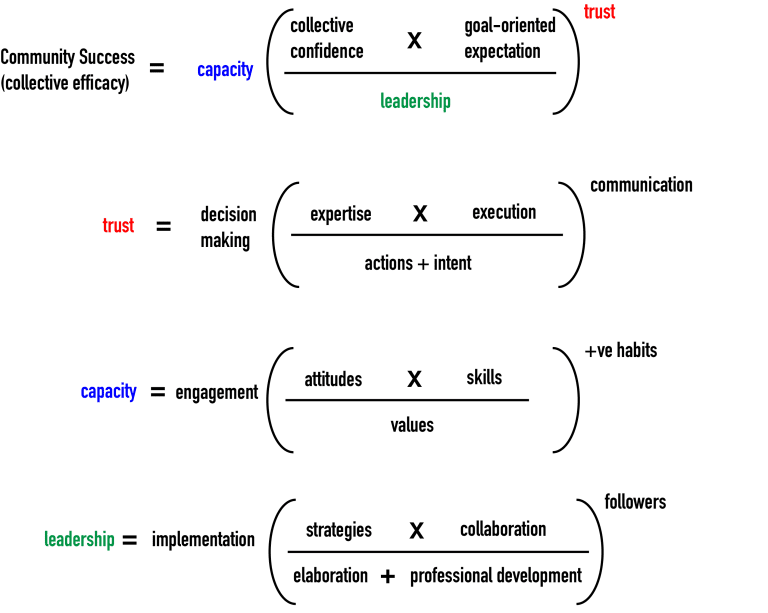
Community success is dependent on the capacity of each team multiplied by the collective confidence times goal-oriented expectations over the leadership at each level empowered by an indices of trust.
If we extract each element…
Trust is the catalyst that creates high performing teams. It is not magical nor mysterious – but it is very delicate. Trust equates to the decision-making we implement multiplied by the expertise of who we have times the execution over the actions and intent (or reason why) of each team group – which is strengthened by communication to gain support – to elaborate so things resonate – amplifying the ’cause’ because it makes ‘sense’.
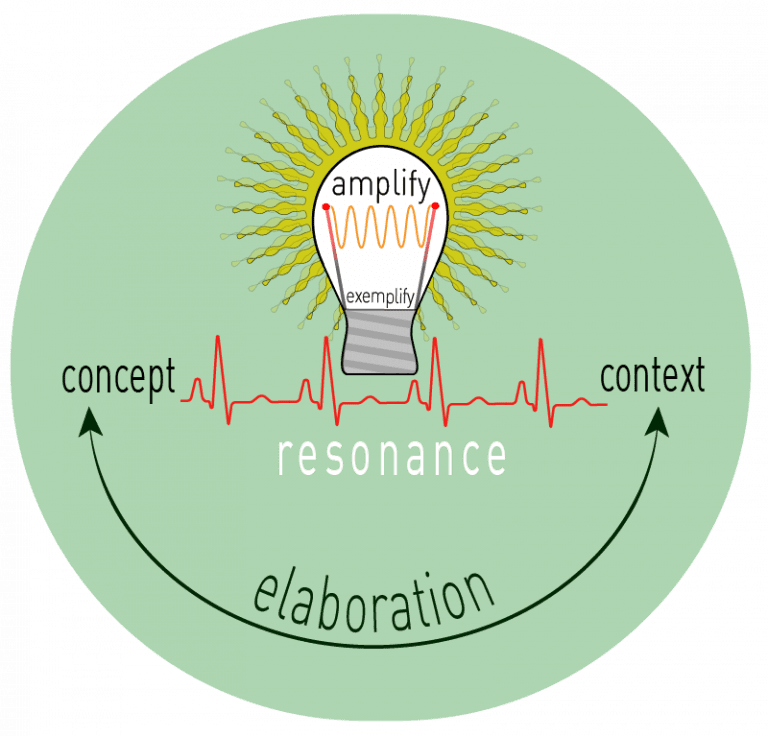
Trust is the fundamental catalyst for any action – or reaction.
As a teacher, I know when parents lose trust in us – their children’s learning changes. The student looks at things differently – not with wonder and awe – but with scepticism and distrust. It is so horrible to see learning wither because the concept becomes clouded by doubt.
Trust allows teachers to feel supported, to feel confident, to focus on the needs at hand – and there are lots of needs.
Now I am not saying trust is ‘blind faith’. Trust is also knowing that we have a responsibility to raise concerns – for the greater good. And we can trust that when concerns are raised, they will be dealt with in “good” faith, in a timely way, with attentiveness to the multi-dimensional factors, and then have decisions made based on the best of intention, the deepest knowledge, and the greatest wisdom for a positive outcome.
But… parents (and management) need to retain awareness of just how much does go into the art of teaching.
Communication is how we elaborate and share common goals and strategies. It is the compost of growing change. Communication is not just talking – or telling. A funny dutchman would say to me: “Enough of me talking about myself – do you like my hair?” Listening is the basis of communication – “to make common”. It is about having feedback loops – and feedforward strategies.
Capacity is the engagement of each player, equipped with the attitudes, the skills over the collective values to the degree of positive habits each member holds in a community. Capacity is like a watering can – we carry it and sometimes it is overflowing, and sometimes it needs topping up. Sometimes it leaks!
Leadership is at all levels – everyone is a role-model – but is really the implementation (getting stuff done) times the strategies with those who can collaborate over the understanding of what is required (so it becomes engrained in culture) which is lifted by quality of the professional development (upskilling) – to create true followership (a lasting legacy). We hear so much about what a leader needs to do – there are books upon books about leadership – but the real power of a collective high-performing team is the followership of the team players. Every player has potential – and every player has a responsibility. If it is not working – it is not the right to make it fit the individual wants – it is the responsibility to find another team – or another game – that works best.
Living School is an organic ecosystem – where we believe there is strength in diversity.
Managing children in a learning ecosystem – is complex and fast-moving. And ‘learning’ is much – MUCH – more than rating a school on its academic bands of success. Measures and standards are important but these are the medals of a competition – and as we know in high-performance sports only three medals are awarded at the Olympics. We know that standing on a podium to accept the accolades for performance is standing on the shoulders of so many supporters. Standing on a podium is standing on years of failure, of hard-endeavour, of strengthening the will to power through, to be resilient.
We also know that some who stand on the podium of elite achievement are not happy people – what I call the Agassi Affect. These ‘athletes’ feel pushed to be someone they are not – or they feel they have “missed out” – lost their childhood.
We grow into adulthood – and happy childhood grows happy adult lives. However, being ‘happy’ is not constant – and so we must educate our youth in how to feel ‘content’. How do we strategise so we can manage our down days – the travesties of broken relationships, bad deals, illness, stress and others?
This is why our expeditions and experiences are designed to build challenge – challenge by choice. And this is why we must explicitly teach learners (here I reference students, teachers, staff and parents) – that there is rich learning experiencing ‘failure’. There is emotion in the process and the feeling of regret and embarrassment – if nurtured carefully – can lead to redirection, to refocus – to have another crack. This – we KNOW – is the success factor – or what Lee Duckworth calls GRIT.
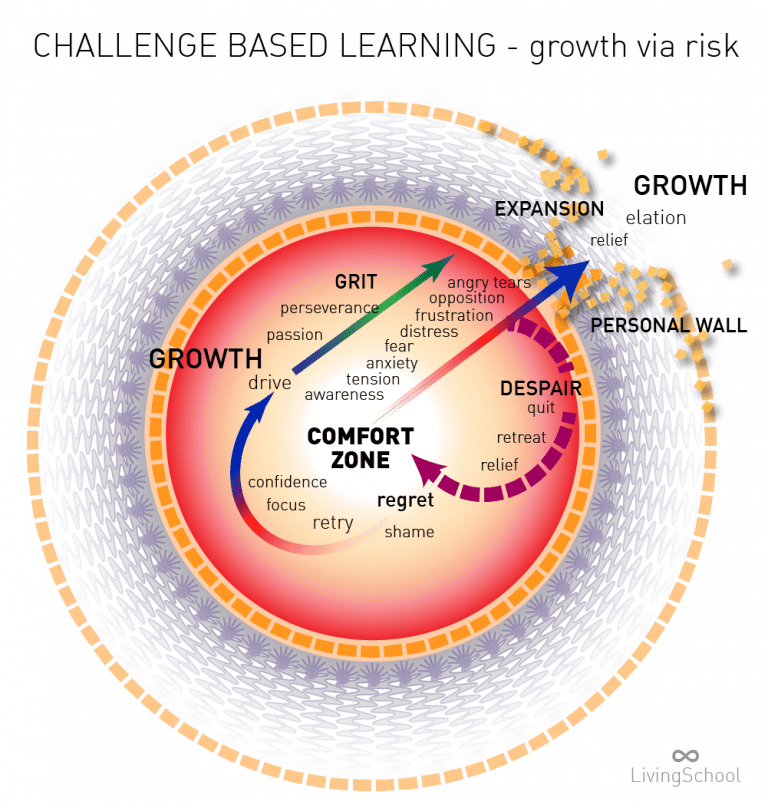
We call it a ‘growth mindset’ – but I would reference it as “mind-flex”. The winners of change are those who can be flexible – as evolution states – it isn’t the fittest but the most adaptable.
The next decade will throw up SO many changes. And is school designed to prepare students for a future – I worry we are stuck in the past thinking quality teaching is transmission of content knowledge – which government can ‘mark’ just as teachers can ‘mark’ students. Living School questions this mainstream belief. Our school challenges indoctrinated acceptance because we MUST.
Living School is engineered around three developmental cycles – primary (intentionally Kindergarten to Year 4); middle school (because we have students developmentally maturing much younger – in Year 5. And we hold our Year 8 students to be leaders in a younger domain – they don’t have to date Year 10 students!). And we have Year 9 jiggled into being the fledglings in an Academy – where the attention is not on challenging the status quo but how we fit into the new ‘world’. These learning neighbourhoods are designed around the four years of development – and offer get on and get off points on the journey: our rites of passage.
Modern life throws up so few rites of passage to establish good character. What is left? Getting a licence? Going into licensed premises? Being able to vote?
Parents and community members have a role to play in fostering and caring for our collective efficacy. Parents need to consider expectations based on the needs of the group. Our teachers need to support all students – to manage the hearts, minds learning and social needs of so many bundles of energy, errors and greatness.
Teachers have a wisdom that stretches across generations – and bring with them their own indoctrinated self. And ‘teacher’ is not a specialised word – it is broad and references ‘educators’, staff, parents, carers and the environment (sometimes called the Third Teacher).
COMMUNICATION THAT IS CLEAR BUT NOT WELL-TIMED: NOT GOOD
As I referenced: Brene Brown said, “Clarity is kindness”. Communication is such an important quality in building trust and sustaining collective contribution. BUT… timing MUST be considered. Our teachers go home to contribute to their own families. So being aware of how needs are managed – and how our incredible teachers also have their family needs – is super important to sustain staff grit. Emails at night are easy – I understand parents are busy people, too. BUT… you can schedule send – so the teacher receives them in their working day. And please – please – do not send any concerning emails late on Friday or on the weekend. The button on the bottom has an option – please consider the right to disconnect. Together, we can sustain this incredible journey with guides who are exceptional and fully committed.

THE QUALITIES FOR FUTURE SUCCESS ARE KNOWN – and more important now than ever before.
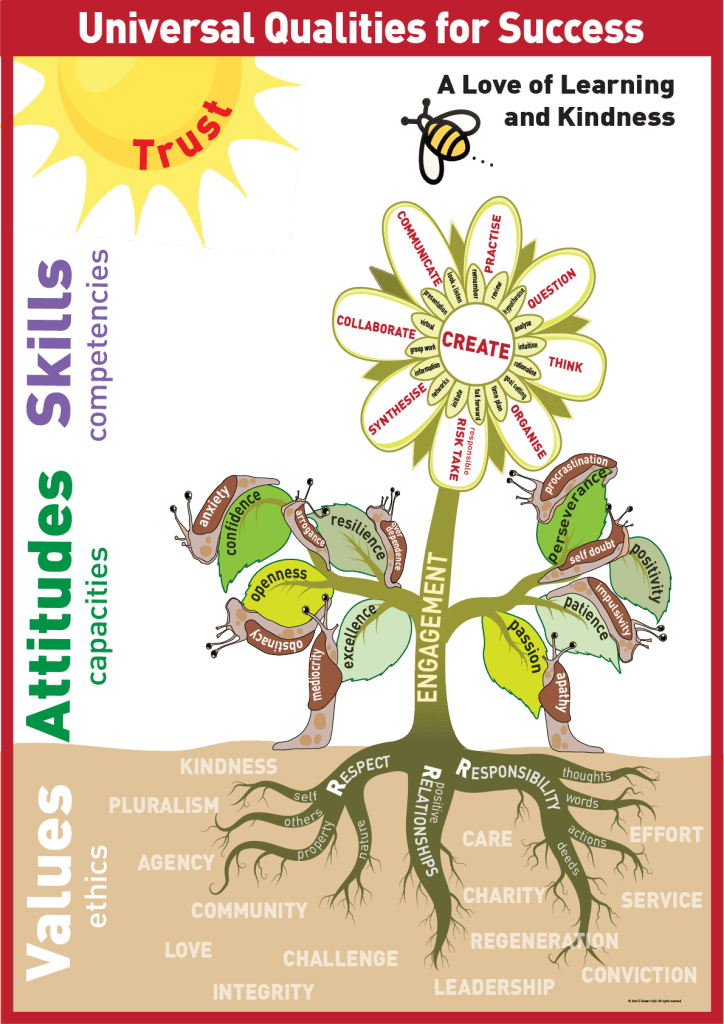
UNIQUELY Living School is our focus on what future success needs. I can assure you this simplicity is not simple – and what some people call ‘soft’, is NOT soft. It is really hard – and it resonates with us ALL because we are all striving to succeed. Our VAST model outlines EVERYTHING our whole-being teaching tackles.
Teachers at Living School develop carefully planned learning experiences around our Values (collective ethical grounding), our Attitudes (capacity to be human), our Skills (the competencies that refine our performance), and all our grown under the goodness of Trust. Trust allows us to take on challenges, to make mistakes, to evolve. As Parker-Palmer stated in a quote I hold dear:
“An authentic spirituality of education will address the fear that so often permeates and destroys teaching and learning. It will understand that fear, not ignorance, is the enemy of learning, and that fear is what gives ignorance its power. Such spirituality does not dictate where we must go, but trusts that any path walked with integrity will take us to a place of knowledge.”
– Parker J Palmer