Inquirers
Skills · QUESTIONCuriosity made disciplined: “I notice… I wonder…” grows into genuine investigation and a lifelong love of learning.

The K–13 Learning & Thinking Continuum shows how your child moves from Belonging in Primary, through Being in Catalyst Middle School, to Becoming in Living Academy — with firm foundations in literacy and numeracy, structured inquiry, and genuine care for the whole learner.
Below is the living map our teachers use. Scroll the neighbourhoods, or jump straight to a conversation with us.
Showing all strands. Choose a lens above to follow a single framework as it matures from K to 13.
Education debates often force a false choice: explicit instruction or inquiry; knowledge or engagement; rigour or curiosity. At Living School we reject that trade-off. Great learning is integrated — it holds all of these together, on purpose — and we never sacrifice a child's engagement and love of learning to do so.
Knowledge connected across subjects through our six keystones, so learning is coherent and memorable — not a string of disconnected lessons.
Clear, well-sequenced teaching of essential skills and knowledge — modelled, practised and mastered — so every child has firm foundations.
Deep fluency in literacy and numeracy, taught rigorously and applied in real contexts, so concepts are genuinely understood — not merely memorised.
Structured inquiry-based learning and hands-on investigation that turn curiosity into disciplined thinking and authentic discovery.
Wonder is protected and cultivated. Engaged learners work harder, persist longer and remember more — engagement drives rigour, it never competes with it.
Clear expectations for academic effort and finishing what we start — building the learning muscles of focus, perseverance and pride in quality work.
You do not need to memorise every framework on this page. Hold these three promises:
English and Maths are taught with clarity and practice — so curiosity has something solid to stand on.
Inquiry, expeditions and creative work are designed in — not bolted on after the “real” learning.
Primary, Middle School and Academy share language and values, so transitions feel like growth — not starting again.
Everything on this page grows from one model. VAST is our shared language for character and capability: Values in the roots, Attitudes in the leaves, Skills in the flower, and Trust as the sun that makes growth possible — all reaching toward a love of learning and kindness.
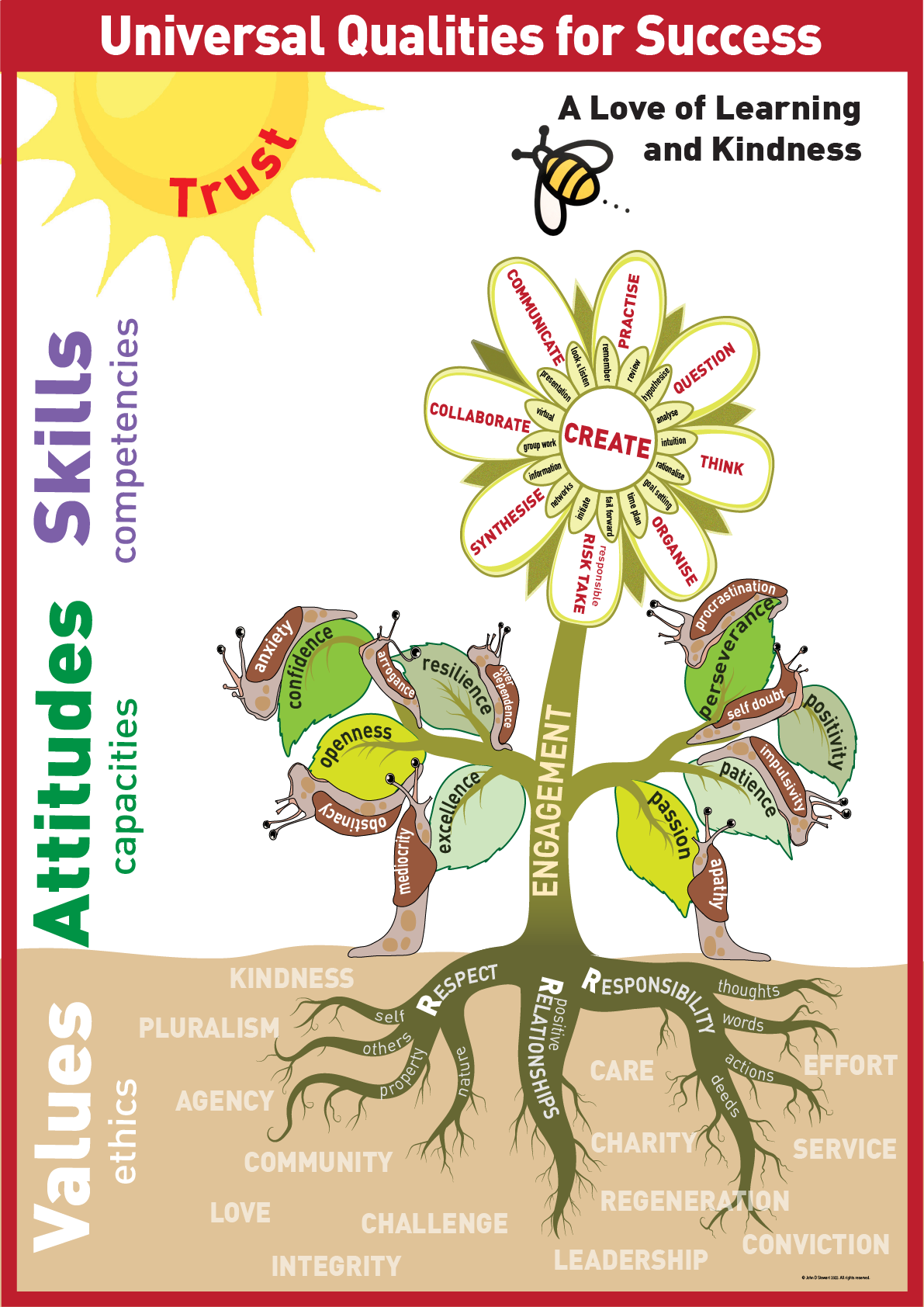
Kindness, Respect, Responsibility, Relationships, Agency, Service, Regeneration, Leadership, Conviction. The “why” we name in every unit.
The dualities we coach: Confidence↔Anxiety, Resilience↔Over-dependence, Perseverance↔Self-doubt, Patience↔Impulsivity, Positivity↔Apathy, Excellence↔Mediocrity, Openness↔Arrogance.
The eight petals around CREATE: COMMUNICATE, PRACTISE, QUESTION, THINK, ORGANISE, RISK-TAKE, SYNTHESISE, COLLABORATE. The verbs in our learning intentions.
Relationships, communication and belonging — the climate of safety that lets every other quality grow.
🐝 “A love of learning and kindness.”
VAST tells us what we grow; the Learning Lens tells us where. Every learner is developed across four domains — held between the spiritual and the social, the intrinsic and the extrinsic — around a core of beliefs, values, attitudes, interests, experiences and skills.
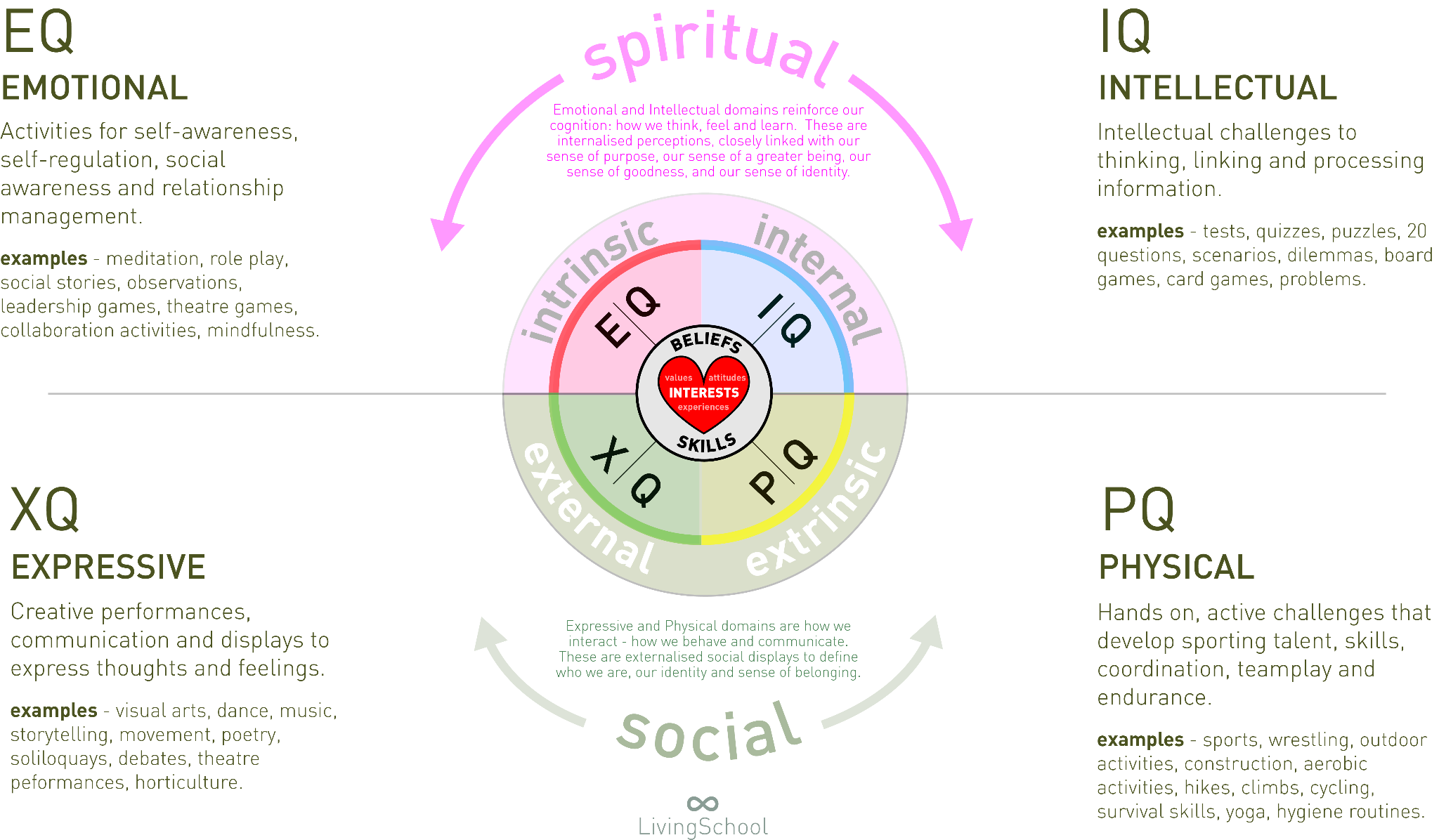
Self-awareness, self-regulation, social awareness and relationships — meditation, role-play, observation, collaboration, mindfulness.
Challenges to thinking, linking and processing — tests, puzzles, scenarios, dilemmas, problems.
Creative performance and communication — visual arts, dance, music, storytelling, debate, theatre, horticulture.
Hands-on, active challenge — sport, construction, hikes, climbs, cycling, survival skills, yoga.
This is what we map intentionally, K–13: the ten attributes of the IB Learner Profile. But we don't receive them as a distant directive from a larger body — we hold them in our own VAST language, so they are unmistakably ours. It is our Lifetime School promise: not only what a child knows when they leave, but the kind of person they have become — and will keep becoming.
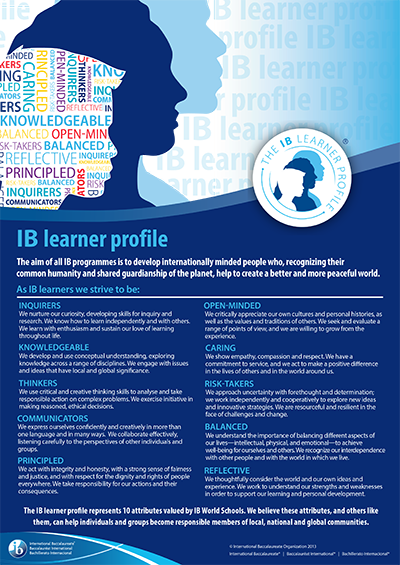
The IB gives us a world-class definition of a successful learner. VAST makes it ours — we translate every attribute into our shared language of Values (roots), Attitudes (leaves), Skills (flower) and Trust (the sun).
Curiosity made disciplined: “I notice… I wonder…” grows into genuine investigation and a lifelong love of learning.
Deep conceptual understanding in English, Maths and beyond — knowledge that connects, not facts that simply sit.
Critical and creative thinking applied to real, complex problems — reasoning we can see, share and defend.
Confident expression and true listening, across more than one language and form — held in a climate of Trust.
Acting with integrity, honesty and fairness — taking responsibility for our own actions and their consequences.
Valuing our own and others' cultures and histories — including First Nations perspectives — and growing through difference.
Empathy, compassion and service that makes a real, positive difference — VAST kindness and Service in action.
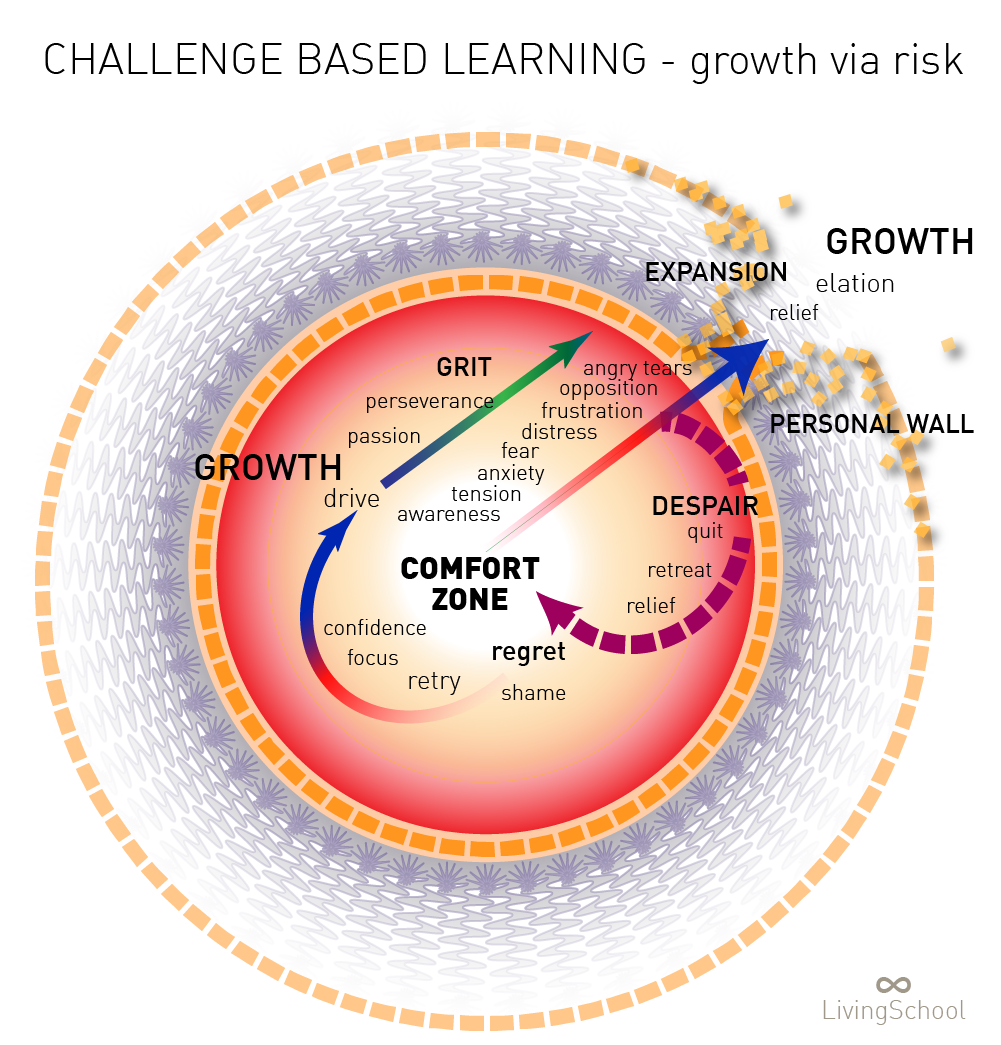
Courage with forethought: resourceful, resilient and willing to try — growth via challenge, never recklessness.
Intellectual, physical and emotional balance — the WholeBeing of ourselves and the people around us.
Thoughtfully weighing our learning and experience — metacognition that powers the next step of growth.
We cultivate the soil of identity, community and respect. Safe foundations for everything above.
The dualities of early adolescence: resilience, perseverance, patience — tested and strengthened.
Agency, leadership and regeneration manifest as real-world contribution and ethical action.
Showing all strands. Choose a lens to follow a single framework as it matures from K to 13 — the tree above and the neighbourhoods below respond together.
Belonging & Sowing Roots Belonging
The focus here is building safe, respectful foundations. We cultivate the soil of identity and community, matching the early phases of inquiry and core personal discovery.
What this looks like for families: belonging, literacy & numeracy foundations, outdoor learning. Ask about Primary places
Tuning In & Finding Out — moving from personal experience to guided, structured discovery.
Ways of Knowing — sensory perception. Core question: “How do my senses help me discover things?” Children observe carefully, describe what they perceive, and begin to tell a fact apart from a story.
The Screen-Light Companion. Years K–2 are deliberately screen-free — thinking is captured orally, through play, manipulatives, story and the teacher as scribe. From Year 3, short small-circle device sessions build keyboard and on-screen test familiarity (NAPLAN readiness); Year 4 introduces 1:1 Chromebooks with foundational digital citizenship.
Six keystone terms, viewed every year through English, Maths (Radial) and our research & thinking tools.
| Keystone term | English | Maths (Radial) | Research & thinking tools |
|---|---|---|---|
| T1 · Identity | Phonics, oral narratives, telling our own story. | Sorting & classifying; mapping personal space. | Y-Charts — how safety looks, sounds, feels. |
| T2 · Nature | Descriptive vocabulary; shared reading of natural systems. | Spotting and continuing patterns in nature. | Observation Journals — change over time. |
| T3 · Life & Living | Procedural sequencing; clear instructions. | Counting, quantifying, simple measurement. | Comparison Matrix — living vs. non-living. |
| T4 · Civilisation | Collaborative storytelling; community perspectives. | Sequencing events; the shape of our community. | Venn Diagrams — then & now families. |
| T5 · Phenomena | Cause-and-effect language; designing questions. | Sorting data; simple transformations. | See–Think–Wonder — surprising events. |
| T6 · Service | Expressive writing; framing a shared goal. | Fair shares; dividing sets evenly. | Consequence Wheels — choices & impacts. |
The Duality of Growth Being
Years 5–8 are transitional and intense. This neighbourhood directly addresses the physical, emotional and social changes of early adolescence by focusing on the VAST dualities (the leaves) and critical thinking.
What this looks like for families: Catalyst years at Brown & Jolly, identity & agency, Thriver adventures. Explore Middle School · Thriver
Sorting Out & Going Further — deconstructing data, analysing perspectives and identifying bias, then moving into Problem- and Project-Based Learning.
Ways of Knowing — shared knowledge & language. Core question: “How do communities decide what is true?” Students weigh perspectives, detect bias and recognise ideological echo chambers.
The Sorter & Conversational Sparring Partner. On 1:1 Chromebooks, students shift from consumers to prompt designers — asking an LLM for the counter-argument or to expose logical flaws — while actively managing their digital footprint and online safety.
The same six terms, now interrogated — English for voice & critique, Maths (Radial) for systemic pattern, research for comparative analysis.
| Keystone term | English | Maths (Radial) | Research & thinking tools |
|---|---|---|---|
| T1 · Identity | Analysing character motivation; personal essays. | Statistics; reading demographic data sets. | Step Inside — exploring other perspectives. |
| T2 · Nature | Persuasive writing; environmental discourse. | Ratio, proportion & scale in natural forms. | Fishbone — isolating ecological causes. |
| T3 · Life & Living | Evaluating informational texts; finding subtext. | Linear relationships; growth & rate. | Systems Webbing — interdependence. |
| T4 · Civilisation | Historical rhetoric; unpacking media narratives. | Geometry & grids; urban spaces. | Claim–Support–Question — critique. |
| T5 · Phenomena | Technical reports; explaining complex processes. | Probability; distributions; experimental data. | Variables Matrix — independent vs. dependent. |
| T6 · Service | Public advocacy; managing team communication. | Budgets; resource allocation. | Criteria-Based Filtering — choosing actions. |
Agency & Systemic Fruit Becoming
The senior years focus on real-world impact, leadership and ethical execution. Students act as self-regulated designers of their own learning pathways.
What this looks like for families: senior pathways, IB learner profile, Living Academy. Visit Living Academy
Making Conclusions & Taking Action / Reflecting — inquiry must manifest as a tangible social, entrepreneurial or academic contribution.
Ways of Knowing — formal systems & ethics. Core question: “What are the limits of our knowledge systems?” Interrogating mathematical certainty, ethical responsibility in technology, and institutional bias.
The Workflow Co-Pilot & Ethical Auditor. Under BYOD with the full Adobe Creative Suite, AI is integrated into professional workflows for coding, design, data synthesis and rapid prototyping — and students perform ethical audits, critiquing algorithmic bias and the environmental footprint of data centres (tying back to the VAST Regeneration root).
The six terms at full rigour — English as formal argument, Maths (Radial) as modelling, research as systemic synthesis.
| Keystone term | English | Maths (Radial) | Research & thinking tools |
|---|---|---|---|
| T1 · Identity | Critical theory; rhetoric; forming a stance. | Multivariate analysis; network models. | Epistemological Audit — examining worldview. |
| T2 · Nature | Ecocritical analysis; drafting policy positions. | Calculus foundations; modelling resource change. | Causal Loop Mapping — ecological balance. |
| T3 · Life & Living | Literature reviews; scientific abstracts. | Exponential & algorithmic modelling. | Ethical Dilemma Matrix — bioethical trade-offs. |
| T4 · Civilisation | Geopolitical discourse; legal-brief structure. | Game theory; demographics; financial systems. | Paradigm Drift — institutions over time. |
| T5 · Phenomena | Technical reporting; peer-review-style editing. | Statistical modelling; calculus; vector fields. | First-Principles Analysis — core truths. |
| T6 · Service | Grant writing; strategic messaging; pitch decks. | Quantitative metrics for impact tracking. | Design Thinking — iterative prototyping. |
At Living School, every concept is learned by doing. Disciplinary depth is explicitly taught, then woven through real connections and grounded in authentic context — most often outdoors, on Country, and oriented to the UN Sustainable Development Goals. This is how learning becomes life-worthy across all neighbourhoods, K–12.
Transdisciplinary links that make knowledge stick — between subjects, across our six keystones, and out to community and Country.
Rigorous, explicitly-taught foundations — then applied in the field, never left abstract.
Real, place-based and outdoor learning — where concepts become conviction.
Our Northern Rivers setting is a living classroom. Hands-on, outdoor learning is mapped to the UN SDGs and tied back to the VAST Regeneration root — growing from caring for our patch in Primary, to community action in the Catalyst Middle School, to systemic advocacy in the Academy.
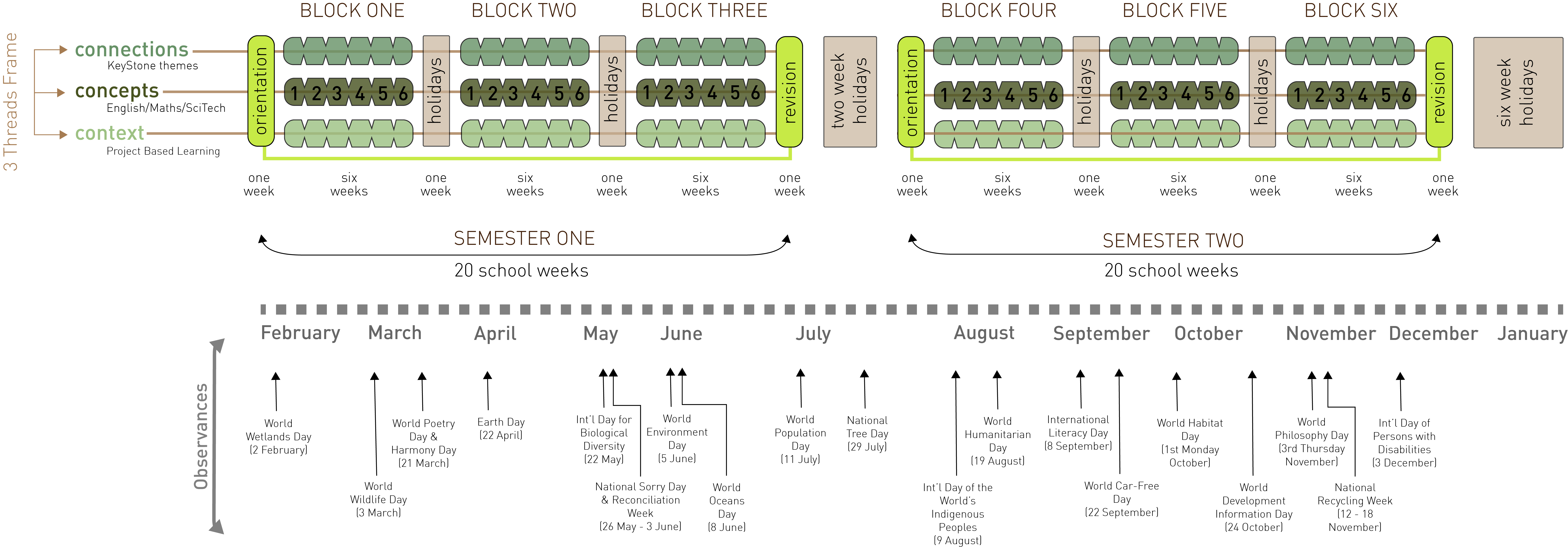
Our calendar is built for depth, not rush. The year runs as six six-week blocks — one per keystone — across two 20-week semesters. Each block is bookended by a one-week Orientation and a one-week Revision, with short holidays between, and is taught through the three threads: Connections (keystone themes) · Concepts (English · Maths · SciTech) · Context (project-based learning).
Semester One · 20 school weeks · Blocks 1–3
Semester Two · 20 school weeks · Blocks 4–6
One block per keystone — Identity, Nature, Life & Living, Civilisation, Phenomena, Service.
A steady, predictable rhythm that protects time for sustained projects.
Deep-work blocks in Years 9–13 give room for studio practice, fieldwork and expeditionary learning — not bell-to-bell fragments.
Connections (keystone themes) · Concepts (English · Maths · SciTech) · Context (project-based learning).
Global observances scaffold real learning — Reconciliation Week, Int'l Day of the World's Indigenous Peoples, Earth Day and World Oceans Day.
HSIE (Human Society & Its Environment) is taught through the same six keystones, deepening from Primary to the Academy. Aboriginal and Torres Strait Islander histories and cultures run through every block as a cross-curriculum priority — learned on Country, in partnership with the Bundjalung Nation and our local Ngulingah community, as living, present cultures.
Each keystone block carries an HSIE focus. The must-know is the non-negotiable understanding every student leaves the block with; depth escalates K → 13.
| Keystone block | History | Geography | First Nations & Country | Must-know by block's end |
|---|---|---|---|---|
| B1 · Identity | Personal & family histories; how we know the past (sources, timelines). | Sense of place — where I live; mapping my world. | The Country we are on & its Custodians; belonging to place. | I can locate myself in place and time and name & respect the Custodians of this Country. |
| B2 · Nature | How people's relationship with the environment has changed over time. | Natural environments, weather, climate & the ecosystems we depend on. | Caring for Country; seasonal calendars & deep ecological knowledge. | I can explain how living things depend on healthy environments and how First Peoples care for Country. |
| B3 · Life & Living | Daily life across time; how communities meet their needs. | Human use of environments; sustainability of food, water & land. | Sustainable land & resource management over 60,000+ years (fire, food, water). | I can compare how communities meet their needs and live sustainably. |
| B4 · Civilisation | Past societies, governance & significant developments; cause & effect. | Places, regions & the connections between them; urban & rural space. | The world's oldest continuing cultures; pre- & post-colonial histories, contact & consequence. | I can describe how societies are organised and recognise Australia's First Peoples as the world's oldest continuing cultures. |
| B5 · Phenomena | Turning points & events that changed communities; perspective & interpretation. | Natural hazards, environmental change & human responses. | First Nations knowledge of sky, tides, fire & seasons; events such as the 1967 Referendum & Mabo. | I can analyse a significant event from multiple perspectives, including First Nations perspectives. |
| B6 · Service | Activism, rights & freedoms; how citizens drive change & reconciliation. | Geographies of inequality; planning fair, sustainable communities. | Reconciliation in action — truth-telling, voice & National Sorry Day / Reconciliation Week. | I can take informed civic action toward reconciliation and a sustainable community. |
Technology is introduced intentionally, not by default. Early childhood is protected for hands, imagination and the outdoors; screens arrive only when they extend thinking — and grow into professional creative and technical fluency by the Academy.
Hands, manipulatives, story and outdoors. Imagination leads; the teacher is the scribe.
Short, supervised device sessions building keyboard and on-screen test familiarity — NAPLAN readiness.
Devices introduced with foundational digital citizenship, docs and responsible use.
Research, creation, prompt design and digital-footprint management across the Catalyst curriculum.
Professional creative and technical workflows with the full Adobe Creative Suite — and ethical auditing of the tech itself.
The same disposition — curiosity, made disciplined — deepens across the school. We begin with a structured inquiry cycle and steadily raise the stakes: from cracking a real problem, to shipping a sustained project, to expeditions that leave the building, to a senior pathway the student chooses.
A structured inquiry cycle: wonder, tuning in and guided discovery. Thinking made visible.
A genuine, messy problem to crack. Students learn to define, research and test solutions together.
Sustained projects with real audiences and public products — the heart of the Catalyst curriculum.
Learning that leaves the building. Thriver expeditions and real challenge build grit, fieldcraft and conviction.
Specialise and qualify — vocational mastery, the IB Diploma, or the HSC. Rigour, on the student’s terms.
Before students specialise, Years 9–10 stretch them in the field — expeditions, service and authentic challenge that turn knowledge into conviction, and reveal where each learner wants to head next.
For students who learn best by making and doing — a route into industry, apprenticeships and skilled trades.
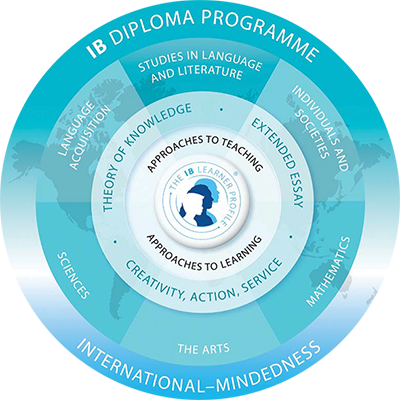 Academic · Standalone
At the SCU Academy (“The Grove of Possibility”) — the globally respected, standalone academic pathway.
The NSW HSC delivered as a hybrid with Horizon Distance Education — rigour that flexes around real lives.
One formula for whiteboards and planners, K–13. It binds a VAST skill, an inquiry action, and a real-world application into a single, plannable sentence.
A whole-school approach to understanding, supporting and celebrating every learner — the same VAST model, applied to wellbeing. The whole child sits at the centre; VAST underpins everything we do.
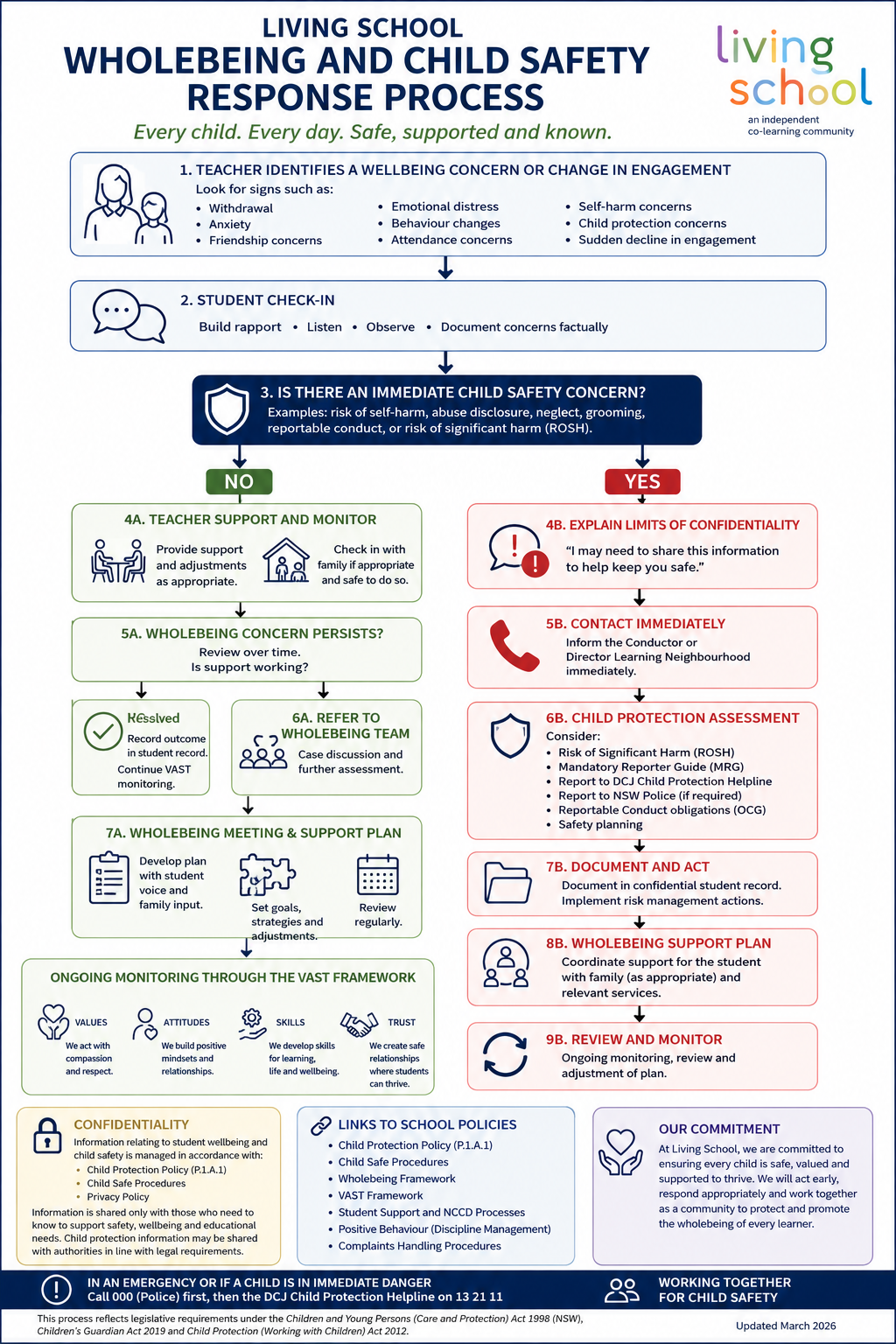
Known · Valued · Supported · Empowered · Included — held by Student Voice & Agency and Family & Community Partnership.
The four NCCD evidence domains run through the cycle, supporting NESA registration, Child Safe Standards and the Disability Standards for Education (2005).
The VAST tree graphic should sit alongside NSW Stage indicators and IB Learner Profile attributes in every neighbourhood. This shows students that their identity (PDHPE/HSIE), values (VAST) and academic skills (IB) are all part of the exact same growth process — not three separate subjects.
A student’s digital profile stays with them from K to 13. It shouldn’t just hold finished work — it should track their metacognition.
Uploads a voice note explaining their See–Think–Wonder routine.
Logs an AI chat script showing how they argued with a chatbot.
Maps their final system design for a community project.
Coordination, not duplication: the thinking portfolio lives in your chosen platform (Toddle, Seesaw, or Google Drive) — these remain the systems of record. Living School tools coordinate and link to that evidence rather than re-storing student work, keeping sensitive learner data where it belongs.
Living School’s continuum runs from Kindergarten through Year 13: Primary (K–4), Catalyst Middle School (Years 5–8), and Living Academy (Years 9–13).
No. We teach the NSW curriculum with clear foundations in English and Maths, and we weave inquiry, values (VAST) and whole-learner care through the same journey — not instead of it.
We refuse the false choice between explicit teaching and engagement. Learners build firm foundations and curiosity; Primary, Middle and Academy share one growth story (Belonging → Being → Becoming).
Years 5–8 at our Brown & Jolly campus in the heart of Lismore — the bridge between primary belonging and senior agency, including Thriver adventure and service experiences.
Living Academy continues the same continuum into Years 9–13, with pathways that include the IB Learner Profile and senior programmes. See living.academy for Academy detail and scholarships.
Read Enrolment information, review Fees, then Apply to enrol or contact us to book a campus visit.
Whether you are exploring Primary, Catalyst Middle School, or Living Academy — start with a conversation. We will walk you through places, fees and the enrolment process.
Or read enrolment information · fees · jump to Middle School strands