
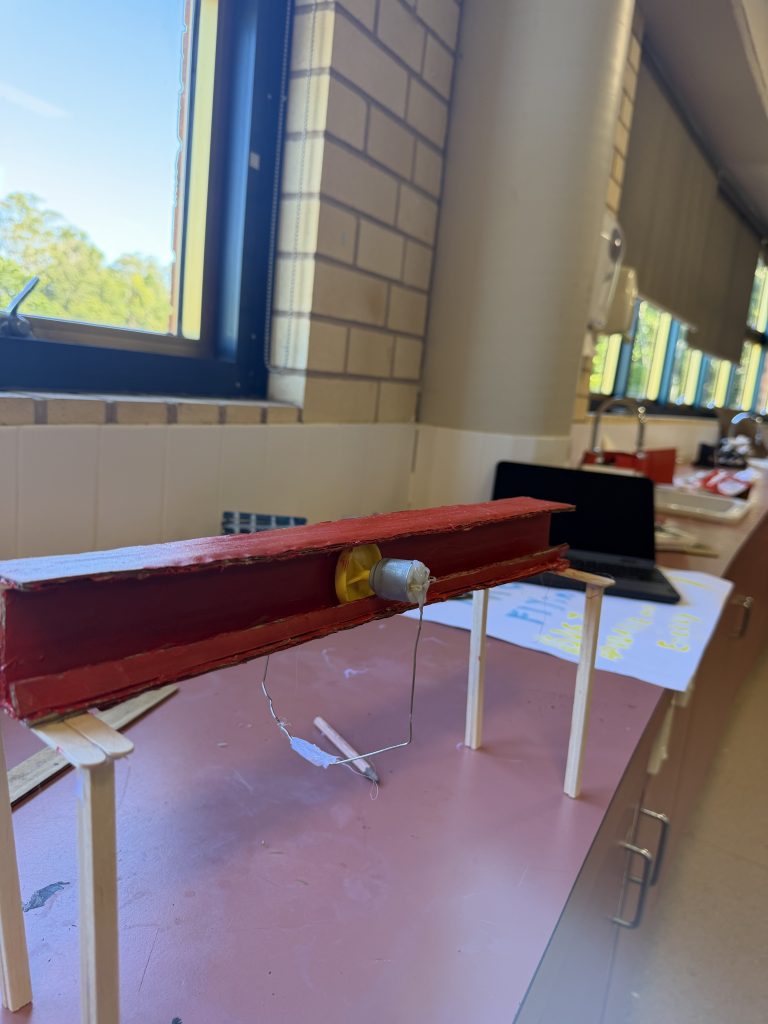
By utilising a replaceable-disk dynamo to capture the momentum of students gliding down a Kinetic Flying Fox, this project converts playground gravity and motion into electrical energy, saving the school relying on grid electricity while supporting a neutral-energy campus.
Design Manifesto
Almost 100% of schools are still connected to the grid with 64% of schools having some form of green energy. With solar being the most common form of green energy, although this is good, solar only contributes to 15% of the schools energy. 85% still comes from the grid which is still using fossil fuels to produce energy.
With my Kinetic Flying Fox it will be contributing to green energy and reducing the energy taken from the grid. Although it would be green energy some energy would be lost due to friction and sound.
Kinetic playgrounds are already a thing all around the world with Singapore, Ghana Mali, Bulgaria, and the Netherlands being the main places they are implemented with Kinetic playgrounds in Ghana and Mali power is used for rechargeable LED lanterns for poor kids to be able to study at night because there not hooked up to the grid . In Bulgaria and the Netherlands, kinetic play equipment is used to power playground lights, sounds, water fountains, and public Wi-Fi hotspots. With my kinetic flying fox added to these facilities all around the world there would be less electricity coming from the grid. With every healthy (8 to 12 year old ) child produces about 150 watts per hour in a power producing park and with an average of 12 kids in a park that adds up to 1800 watts per hour 0r 1.8kws per hour.
The kinetic flying fox produces power by transferring potential energy to kinetic to electrical and then stored energy.
how it works is when someone grabs onto the flying fox and it starts moving it is transferred from potential to kinetic energy then the kinetic energy is turned into electrical energy through a dynamo then hooked up to a dead battery that when charged can be used for charging your phone and extra. The design will have a few inconsistencies like the amount of watts it generates due to wind, weight, the speed that they push off with, rain/water, and air resistance.
But on average it would produce roughly 55.5.. Watts per trip if my calculations are correct but I'm not sure.
The Problem
How might we design a kinetic flying fox playground system that converts student gravity and momentum into electrical energy, helping the school reduce its grid reliance and redirect electricity costs back into education?
Our Sustainable Solution
Aim:
is to reduce /half nonrenewable energy that we take from the grid.
Hypothesis:
The design will have inconsistencies due to many different factors for example weight and wind
If I were to make this then it would be expensive because the materials would be slightly more costly but would save money in the long run.
Method and safety
-
Student grabs on to the flying fox and pushes off
2. Then the kinetic energy is transferred to the dynamo
3. The dynamo transforms the kinetic energy to electrical and how it does this is it spins a copper coil around a magnetic field and forces the electrons to move transforming energy from electromagnetic energy to electrical energy
4. The electrical energy is transformed into stored energy in a battery that later can be used to power electronics or used instantly to power lightbulbs
My research shows that an average 200 kid school would use between 50000 to 100000kwh. This is very costly, about $43000 and if we could reduce this by even 10% that would be money going towards the kids education and repairs for the school.
With my kinetic flying fox every use is 55.5.. Watts per trip and with every kid using it once a day that's 1111.11 watts per day times that by 200 that's 222222.22 watts per year divide that by 1000 that's 2222.22 kw per year and that's $700 saved just from one flying fox.
Gravity- Non contact forces- This force is always pushing down on the kinetic flying fox so no matter how much speed as long as this force is acting on it it will stop eventually
Friction- contact force- the force slows down the flying fox due to the contact of the dynamo with the eye beam and transforms that energy into heat energy.
Energy Transformation: the energy starts as potential energy and is transformed into kinetic energy when you push off . The dynamo's kinetic energy is transformed into electromagnetic energy where it is finally transformed into electrical energy.
Energy transfer : when you push off and the handle bar has kinetic energy then transferred to the dynamo.
potential energy: when the handle bar is stationary and waiting for the next person to use it.
Energy Transformation: the potential energy is turned into kinetic energy when someone
uses it.
Energy transfer : When the handle bars kinetic energy is transferred to the dynamo.
Energy transformation: when the dynamo´s kinetic energy is transformed into electromagnetic energy.
Energy transformation: the electromagnetic energy is transformed into electrical energy
Problem Solving
The biggest engineering challenge identified in a system like wear and tear on the dynamo. Over a few months of continuous use causes the dynamo to be faulty This causes two major failures in the system:
-
Because the dynamo isn't perfectly circular it doesn't go as fast and as it normally would and the dynamo produces energy based on distance and speed and with lower speed it produces less energy. Causing it to be far less efficient
2. Because the kinetic fox is no longer going as fast it could stop before reaching the end causing the person to have to drop down eventually leading to them possibly land wrong
Engineering Modification
To solve this problem there will be a screw that can be removed to take off the spinning plastic disk and replace it .
Instead of replacing the entire dynamo and buying a new one it can be fixed in a matter of minutes.
Every month a staff member or a school kid can check to see if the plastic disk needs replacing.