
A great challenge in all schools is guiding the behaviour of students, teachers and parents. What is behaviour? What is ‘good’ behaviour? Good behaviour is defined by the person judging the behaviour – it is based on a set of values, and beliefs (forged from experience); and “good” behaviour is defined by what a system or an ecosystem deems to be ‘good’.
A school creates policies based on law. These policies relate to legislation on child protection, safety (including cyber), acceptable ‘punishment’ (no school can permit corporal punishment), attendance, needs – we have a legal responsibility for meeting identified individual learning needs, risk and accreditation. These are non-negotiable.
When I interview parents and I ask them what they want for their children on enrolling in Living School, the majority respond they want their children to be happy and to attain their potential. These two goals are unattainable: we can never ‘attain’ our potential because we have a myriad of influences and time constraints but we can find purpose; we are never consistently ‘happy’ – but we can be content during the emotional waves of life.
Dr Michael Bernard created a great program – You Can Do It! – which framed the purpose of schooling to develop socially, emotionally, behaviourally and academically confident humans, what he referenced as Achievement, Relationships and Well-Being.

In the above model, Bernard defines 5 keys: Getting Along, Organisation, Persistence, Confidence and Resilience. He goes on to define the ‘habits of mind’ attitudes that promote success: social responsibility, playing by the rules, thinking first, being tolerant, planning time, setting goals, working tough (applying effort), trusting in the ability to do it, being independent, taking risks, and self-acceptance.
There is a support document for parents in developing these five keys – click here.
Art Costa and colleagues created a model by researching the traits of successful people, which became the Habits of Mind. As he says, “16 attributes of what human beings do when they behave intelligently” click here.

The Habits of Mind grew on the work of John Dewey, the father of ‘progressive’ education, who outlined “the purpose of education to be the cultivation of thoughtful, critically reflective, socially engaged individuals rather than passive recipients of established knowledge” click here.
If we accept the premise our children are entering a knowledge-based society, then it is wise we consider “how” schools “teach” this – or as Hargreaves says:
“Teaching for the knowledge society, I argue, involves cultivating these capacities in young people: developing deep cognitive learning, creativity and ingenuity among pupils; drawing on research, working in networks and teams, and pursuing continuous professional learning as teachers; and promoting problem- solving, risk-taking, trust in the collaborative process, ability to cope with change and commitment to continuous improvement as organizations.”
(Hargreaves, 2003, p. xviii)
Therefore ‘learning behaviours’ expected in a ‘school’ must be supported by the parents/carers at home – and may challenge the values of the parent, as the behaviours we extol are socially connected with expectations to develop positive habits of mind in a school setting – which can jolt personal memories of injustice in people who felt hurt, unkindness and disrespect in their own personal schooling experience.
At Living School, we care for the individual learner as a child but also as the adult who will thrive, with purpose, in a community of the future. We act to instil the social expectations of a good community, which the child will face and in which the adult must thrive not just survive.
Students who seek ease over effort – avoid challenges and experiences – risk not fully form into independent, successful, enlightened adults.
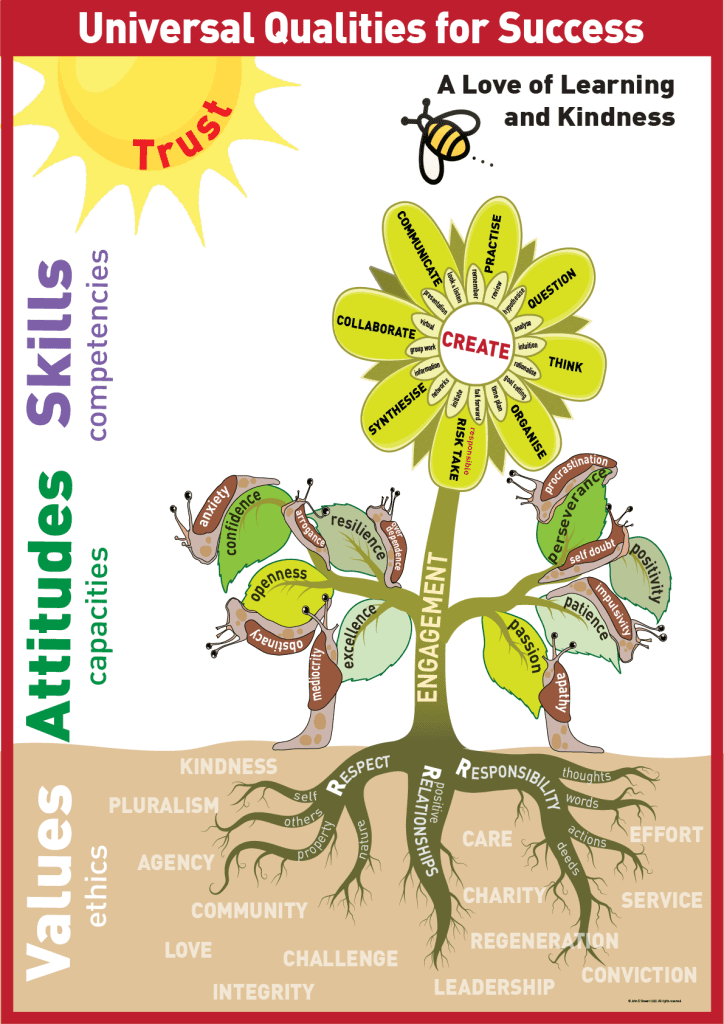
Living School has a unique learning lens outlined as VAST – which has been developed and refined from all of the teachings listed above. VAST is the foundation of success, sown in a good, caring, committed community.
Trust is represented by the sun. It is no accident. Trust shines light on all areas of growth. Trust empowers life. Trust is the enabler.
Supportive School Environment Model
The philosophical principles behind effective behaviour support processes:
- Student behaviour needs to be considered from a systemic perspective.
- Promotion of a supportive school environment encompasses physical, cognitive, social, emotional and spiritual dimensions.
- Behaviour is skill-based and must be taught.
- Behaviour support programs must foster inclusiveness, catering for diversity of student needs.
- Behaviour support programs should be student centred.
- Student behaviour is closely linked to the quality of the learning experience.
- Positive teacher–student relationships are critical to achievement of behaviour and learning outcomes.
- Effective behaviour support requires collaboration, with sound internal support structures and links to professional support agencies.
- Behaviour challenges are learning opportunities for all.

Behaviour in School – the three streams: ROC.
There are three major streams converging that power ‘good’ student behaviour in schools. What needs to be made clear is that these are the responsibilities of not just the student. Both teachers and parents also play a significant role in the partnerships.
Relationships – relationships are four-way webs: student to teacher; teacher to student; parent/s to teacher; teacher to parents.
- Student to Teacher: for a student-teacher relationship, engagement and “good” behaviour relies on trust: the belief a teacher cares, is consistent, is committed to giving of their best, is personable and professional. If peers ‘like’ a teacher, the group consensus has a major bearing. Some teachers engineer relationships better than others, as in real-life. Sometimes, the ego of the ‘sage on the stage’ longs for students’ praise. Sometimes the most ‘loved’ teachers are not always the soundest educationally.
- Teacher to student: teachers are professional – and establish relationships that are fair but with high expectations. Many teachers start a new year with a new class with strong boundaries: rules by which the students must abide. Over the course of the year, the teacher steadily
- Parent to Teacher: parent and staff relationships are vital for successful schooling. It is easy to establish – parents should ALWAYS in front of children and children’s friends support the school – even if they don’t. There is nothing to gain from telling children negative thoughts or by engaging in adult tales (trouble bubbles, carpark conventions, WhatsApp opinions). Such actions and gossip so rapidly erodes trust.
Organisation – to learn requires a student, a teacher and a parent to be purposeful, disciplined and organised.
- Student organisation – students must have the correct resources to learn. They must attend. They must ‘know’ what’s happening. Some students are disorganised – and so they need extra focus and clear strategies, such as lists, proper stationery, time measures, goal setting, colour-coded sections in folders, labels and a significant defined ‘area’ to study.
- Teacher organisation – if a teacher is disorganised or does not commit to deadlines: tardy marking, breaking promises such as not going on camps or excursions. And if a teacher sets a ‘broad’ expectation – such as a project – but does not ‘chunk’ the process into smaller steps, students can feel overwhelmed.
- Parent/Carer organisation – parents have a responsibility to get their children to school on time and regularly with the correct food, correct clothing, correct equipment. Organisation for parents also persists at home. Having good routines, expecting and ensuring enough sleep, reducing the reliance on screen distractions are so important for good learners. And, also, overly-organised parents can create overly-anxious students whenever there is an experience that is out-of-the-perceived-normal.
Curriculum – the course of study and the understanding of attainment levels is the navigation chart for a student’s schooling future.
- The curriculum is the domain of the professional teacher. Teacher knowledge, practice and professional development are the three domains of the Australian Professional Standards for Teachers. These standards detail the focus areas for knowing students, knowing how they learn, knowing the curriculum and how to teach it, assessment and feedback, and professional engagement. With experience the teacher grows.
- When setting work for a class there are blanket expectations for ‘age’ appropriateness. However, if the work is too difficult for a learner’s capability, frustration will manifest. And if work is too easy, boredom will set in. Both result in disruptive behaviour. There is a goldilocks’ zone – where the learning complexity is just right to challenge.
- Parents are expected to work with the teacher, respectfully. Parents must also not relinquish support for the key areas of at home reading, counting and measuring.
Supporting Learners
The classroom teacher/subject teacher is the first point of support. Depending on which key is causing the behaviour will result in a different channel of investigation and support.
Intensive, Individualised Support:
A student who has received universal and additional targeted supports and is not achieving proficiency, requires tier three or intensive, individualised support. This support is more explicit, groupings become smaller and the frequency of monitoring increases. Support may be provided by a specialist within the school and documented within the collaborative planning process to clarify the specific learning needs of the student.
Individual Plans and Function-based Behaviour Support Plans may also be included. Additional expertise and collaboration both within and outside of the school is typically sought at this tier. It is expected that up to 5% of students may require this more intensive, individual, intervention.
Additional Targeted Support:
When screening and monitoring identifies that a student is not thriving within the tier one universal support, a short- term intervention with additional teaching is activated to supplement the universal instruction. This is referred to as tier two or targeted support. This tier also caters for interventions to teach and support development in the social and behavioural skills required for targeted students. This may involve small group, strategic support, usually provided by the class teacher. It is expected that 10-15% of students may require this level of targe intervention.
Universal Support:
All students benefit from instruction in an inclusive whole school setting incorporating evidence-based teaching strategies. This is referred to as tier one or universal support. All students receive effective, evidence-based instruction for academic achievement along with school-wide implementation of proactive practices to promote positive behaviour. Effective universal support will be sufficient for 80-85% of students to attain appropriate levels academic and social proficiency.

Our Collective Code of Conduct will be most effective in nurturing a caring environment. Where behaviour is not in accordance with our Code, it should be called out and dealt with promptly and appropriately. With everyone’s co-operation in striving for high standards, it will become a code which will not need enforcing, but by which the whole community can happily live and work together.
To this end, our community’s culture is developed over time. Our emphasis is on empowering the positive attitudes that nurture a collective mindset.
The code identifies the following areas:
1. RESPECT FOR THE RIGHTS OF OTHERS
Students are expected to respect the rights, needs and feelings of others. In return, they can expect such consideration to be shown to them. Everyone must act in a way which promotes the dignity, health and safety of others.
In particular, no-one should initiate or be expected to tolerate:
- Bullying, intimidation, teasing or ostracising (verbal or physical);
- the use of language which is offensive;
- offensive use of electronic communication.
Public displays of intimate behaviour between students may cause offence to others and are therefore not appropriate.
2. THE SCHOOL ENVIRONMENT
It is everyone’s right to have a safe, clean and comfortable place in which to work. Looking after the environment is the responsibility of us all.
- Interfering with School facilities causes inconvenience and discomfort to others.
- Dropped rubbish causes our environment to be untidy and unhealthy. Rubbish bins are provided and should be used.
- Matches and lighters must not be brought on to the School campus. Smoking is forbidden at all times on the School campus, on the way to school, on school expeditions and when representing the School.
- Food and drink should only be consumed in designated areas and at appropriate times.
- Students should be responsible for helping to keep the campus clean and tidy. This will assist and support staff in their work.
3. COURTESY
Courtesy is an important part of our daily lives. It costs nothing but shows our respect for each other and makes life more pleasant for everyone.
Courtesy involves, for example: speaking politely, listening carefully, doing as requested, making visitors welcome, not interrupting conversations, not pushing. These are not rules, but simply positive ways of behaving towards each other.
Examples of courtesy would be:
- Addressing each other by name whenever possible;
- Using polite language such as ‘Excuse me’, ‘Please’, and ‘Thank-you’;
- Apologising if you accidentally hurt or inconvenience someone;
- Having the correct equipment and appropriate materials for each lesson;
- Entering a room quietly;
- Apologising and giving a reason if you are late;
- Showing respect for other people’s views and opinions and not ridiculing their mistakes;
- Packing away your lesson materials only when asked to do so;
- Doing as requested by a member of staff;
- Shaking hands and looking at the person;
- Not using offensive or obscene language.
4. MOVEMENT
For safety reasons everyone must take care when moving around our campus. Some times our pathways and staircases get crowded.
Students should:
- Take particular care in the vicinity of younger students.
- On staircases, give way to visitors and other adults, and help anyone whose hands are full.
5. PERSONAL PROPERTY
Everyone should take responsibility for looking after their own property. It is recommended that items of significant monetary or personal value are not brought into school.
- Students must not interfere with other students’ property in any way. This will be viewed very seriously.
- Items such as personal audio systems and mobile phones must not be used during school hours unless approved by the teacher on duty as part of the learning experience.
- Clothing and personal items should be clearly marked with the student’s name.
- VALUABLES MUST NOT BE LEFT UNATTENDED.
- If there is any damage to or theft of property, it should be reported promptly to the Office.
6. ATTENDANCE AND PUNCTUALITY
Absence of even one day will cause students to miss lessons and lose out on essential teaching. Students must avoid being absent unless they are unwell or have some other legitimate reason to miss school.
- Students must register daily with the Office.
- Students are expected to be punctual.
- A student who is absent for any reason must either bring a note explaining the absence to the teacher on the first day back, or his/her parents should communicate with the School Office with an explanation.
- Teachers should be informed by parents in advance of any appointments (e.g. medical/dental) during school time. Whenever possible, appointments should be made out of school time.
- Students arriving late should register with the Office, who will record late arrival.
- If parents are seeking to take a child from the school during the day, the parent must see the Office for an exeat and present the exeat to the teacher caring for the child.
7. LEAVING THE CAMPUS
The School takes very seriously the responsibility it has for students whilst in session. We need to know who is on the campus at all times.
- Students may only leave the campus during the day with the permission of a teacher.
- Any student leaving the campus, must sign out with the Office prior to departure, and sign in when they have returned.
8. PERSONAL APPEARANCE
The School recognises the need for tidy, safe and comfortable attire on our campus.
- Students are responsible for their personal appearance and are expected to take pride in it.
- Students may wear casual clothes appropriately – however, we do not condone logos or statements that are offensive.
- Students are responsible for how they dress, however, students must wear clothing that is reasonable and adheres to our school’s good standing.
- Footwear and clothing must ensure safety is a priority.
9. OUT OF SCHOOL, REPRESENTING THE SCHOOL, AND TRAVELLING TO AND FROM SCHOOL
Each member of the School represents the whole community and must strive to maintain the high reputation that Living School enjoys.
Good behaviour and appropriate attire and language are expected at all times when representing the School at events, taking part in expeditions, trips or travelling to and from School.
WISE CHOICES – MANAGING THE CONSEQUENCES OF UNACCEPTABLE and NEGATIVE BEHAVIOUR
Living School has at its heart the new 3Rs values:
- Respect – for self, others, property and the environment.
- Responsibility – for thoughts, words, actions and deeds.
- Relationships – that are positive and productive.
It is important to note, Living School views behaviour development as a key aspect of learning and personal development.
This document is to be read with our Positive Behaviour Management procedures. Emphasis will be placed on guiding, working with parents, and supporting the individual to make positive choices for the benefit of the broader community.
However, there is a time when the needs of the whole will override the needs of the individual. This is when we identify and record behaviour that must be corrected.
Living School adheres to a 3 sanctions policy. The language is intentional so all can clearly understand the seriousness when a sanction is given. Sanctions are a recording of elevated negative behaviour, which must be regulated. All students have a responsibility to address and appropriately modify poor behaviour choices.
Our Code of Conduct is an agreement to uphold our school values.
As educators, we take it on ourselves to support and guide appropriate behaviour with the hope one sanction will result in a positive change in behaviour.
We allow the student to ‘clear’ sanctions after a term, or determined time, so that there may be a fresh start offered. Timing may vary depending on the seriousness of the situation. It is important students and parents know a Sanction will last for at least a term, sometimes a semester, and – in some serious cases – a full academic year.
These considerations will be supported by the Conductor, may be reviewed by the Guardians of Purpose if/when requested as a right of appeal, but – if three sanctions are breached, it may result in the withdrawal of an enrolment at Living School.
The following is an outline of inappropriate behaviour and the consequences to be considered. This is not an exhaustive list and it is intended as a guide which will be a working document.
Depending on the specific situation, ie the age, frequency, repetition and circumstances, consequences may vary.
The document’s table highlights the Level of Intervention with the LEVEL column indicating the roles assigned.
Living School is a co-learning community school. This means we require the support of our parents/carers to abide by our guidelines. All parents have signed a Parent Code of Conduct. If parents/carers are unable to support the school in its undertakings to develop the culture and behavioural expectations, enrolment will be impacted.
Access to our Wise Choices as a .pdf
ENROLMENT INFORMATION
We will assess all applications to enrol against the following criteria:
- Siblings of students already enrolled in the school may be given priority for enrolment.
- Applications for enrolment are prioritised according to the date order of receiving the application for enrolment.
- While it is not a specified criterion in the Enrolment Policy and Procedures, when the number of available placements is limited, it is appropriate to consider the age and development of a child when discerning between applicants who are equally qualified.
Factors for consideration
When considering whether a student will support the ethos of the school the following factors will be considered:
1. the capacity to self-manage, study independently, stay safe and adhere to the Living School’s VAST model (in settings inside and outside of the school campus).
2. The ability of the prospective student to benefit from the educational offering of the School.
3. The ability of the prospective student to contribute positively to the Living School community.
4. The student and family’s preparedness and capacity to embrace the school’s community-centred holistic learning approach.
The school will not discriminate against students according to disability, race, gender, or denomination.
In the enrolment document, it states, clearly, for anyone enrolled in Living School…
Section 11
Application for enrolment in the Living School means that you are making a commitment to support the philosophy, values and aims of the school and a willingness to co-operate in their implementation. Parents are reminded of the school’s Code of Conduct: failure to abide by these expectations, or behaviour that may call the reputation of the school into question, could result in the loss of enrolment for your child/ren.
Your child is required to meet the school’s high expectations basically described as a love of learning and being kind. To detail this more fully, our expectations of your child are clear:
- behaviour and self discipline including adherence to anti-bullying policies
- compulsory attendance at school
- application to course work and study
- participation in school activities
- participation in the life of the school
- dress codes, e.g. non-offensive and safely wear as/when directed
Your co-operation is essential to assist your child to attain these expectations. Parents are expected to participate in the total life of the school through events and activities.
On acceptance of enrolment, you agree to support all the Living School’s policies and procedures.