
REIMAGINING EDUCATION
The Living School Difference
By John Stewart, Conductor of Living School
At Living School, we are reimagining education for a world that needs conscious, capable, and connected humans. Not just people who know – but people who can learn. Because in the 21st century, knowing alone is no longer enough. In a world bursting with information and misinformation, it is how we learn and how we think that defines who we become. Learning is much more than ‘knowing’ – which can be forged in ego and identity at the loss of reverence for others, which risks undermining our care and responsibility for those less fortunate. To this extent, holistic (whole) learning is about being, belonging and becoming – intellectually, culturally, environmentally, socially, emotionally and physically – what Bloom expressed as the three domains: Cognitive, Affective and Psychomotor. And we need to top up our capacity in all of these ‘human being’ domains throughout our lifetime – lifelong learning.

SHIFTING EDUCATION SYSTEMS GLOBALLYT
The OECD’s scenarios for the future of schooling make it clear: education systems around the world are shifting.

The OECD’s scenarios for the future of schooling make it clear: education systems around the world are shifting.
Whether it’s schooling extended, outsourced, embedded in communities, or fully transformed into learn-as-you-go models: change is inevitable. And necessary.
Here at Living School, we are choosing to be at the forefront of that change. Through our progressive learning model and the upcoming implementation of the International Baccalaureate
(IB) Diploma Programme, we are proudly positioning our learners in a globally connected, values-driven context. The IB’s Theory of Knowledge (TOK) course sits at the core of this vision, encouraging students to question not just what we know, but how we know it. It’s an essential skill in an era where sensational headlines and social media snippets compete with credible knowledge.
“The illiterate of the future are not those who can’t read or write but those who cannot learn, unlearn, and relearn.”
– ALVIN TOFFLER
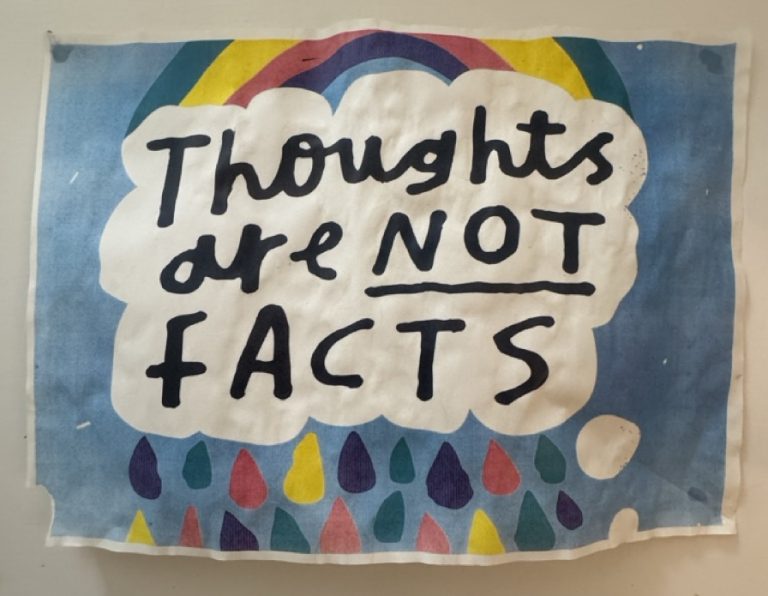
THOUGHTS ARE NOT FACTS.
As educators, and as a learning community, we carry a responsibility to cultivate metacognition: that is, thinking about our thinking. We teach our young people to pause, reflect, and ask: Is this true? Is it biased? What do I value? What evidence supports my view? Because only then can we move beyond surface-level opinions and engage with the world authentically.
In the words boldly pinned to a wall in our school: “Thoughts are not facts.” It’s a simple phrase, but it carries profound weight. If we can teach our learners that feelings and fleeting thoughts need not define their identity or worldview, we give them emotional tools to navigate life’s complexity with grace and resilience.
This emotional regulation, too often dismissed or sidelined in traditional models of education, is central to building inclusive and just communities. Overcoming racism, sexism, ageism – any of the destructive “isms” – requires a deep emotional awareness filter and a commitment to be better. And that starts with being willing to learn differently. To unlearn where necessary. To relearn with humility and humanity.
Learning is truly a lifelong process – spanning every stage of our lives. Our job as educators is not just to fill minds, but to light fires (with reference to Plato). To give each learner, no matter their age, the courage to grow, change, and stay curious. This is not ‘new-wave’ thinking – it is historic and humanistic (ticks all of the boxes!).
Ultimately, it is our relationships that anchor this journey. Safety and trust are not extras – they are the foundations. When learners feel a sense of belonging, when they feel heard and valued, they are ready to engage, express, and evolve.
ADAPTABILITY AND SECURITY
So, as we enter this next exciting chapter of Living School, with our IB journey unfolding and our purpose deepening, let us celebrate not just what we know, but how we keep learning. Together. With all that we have experienced as a young school – it is our adaptability and feeling a sense of belonging that keeps us all balanced on this tightrope of life.
“A transformed school will not look like that brick building set apart from the society it is intended to serve. A transformed school will be an integrated part of the community and its students will be active participants and contributors to the community. In short, a transformed school will look more like life.”
- Shift Ed: A Call to Action for Transforming K-12 Education, Houle and Cobb 2011