
Policy
Living School will provide a safe environment where in the unlikely scenario there is a need for evacuation or lockdown, the community is well-trained and prepared to ensure safety of all is maximised.
DEFINITIONS
What is an emergency drill?
An emergency drill is a focused activity that allows staff, students, and administrators to practice specific functions in a simulation of emergency situations. This offers the opportunity to test preparedness of the school staff and students in case of an emergency by using drills (fire, a shelter-in-place or lock down drill) to familiarise the community with procedures. Performing these drills is necessary to ensure the safety of those on campus during a variety of types of emergency situations and is an essential piece of Living School’s overall preparedness strategy.
What is a fire drill?
A fire drill is an important practice and a test of our fire evacuation and response procedures. It’s best that they be routinely scheduled to allow staff and students to familiarise themselves with procedures and protocols for proper and safe evacuation techniques. This gives teachers and staff the opportunity to practice the proper supervision of students; gives students an understanding of the importance of following instructions during an emergency situation; and administrators the opportunity to see where there is room for improvement to our emergency response system.
What is a lock-down drill?
A lock-down drill is a procedure practiced to secure the building and the occupants of that building from some type of danger, such as a rabid dog, a threatening or armed person on campus, or other unexpected threat. There are two types of lock-down; an emergency lock-down during an extraordinary event on campus such as a gunman or bomb threat, and a non-emergency, preventive lock-down, such as when there is a danger in the neighbourhood that could become a threat on campus.
What is a critical incident?
A critical incident in the context of a school is any event or situation that poses a significant risk to the safety, wellbeing, or security of students, staff, or others within the school community. These incidents may disrupt normal school operations, require immediate response, and often necessitate external support or intervention. In New South Wales (NSW), schools are required to have clear procedures in place to manage and respond to critical incidents, aligning with the relevant legal, regulatory, and duty-of-care obligations.
Critical incidents may include, but are not limited to:
1. Physical or Psychological Harm:
- Serious injuries, accidents, or medical emergencies involving students or staff.
- Incidents of severe bullying, violence, or harassment.
- Events leading to significant psychological distress, such as exposure to trauma or loss of life.
2. Health and Safety Risks:
- Emergencies such as fires, floods, or natural disasters.
- Hazardous material exposure or dangerous equipment failures.
3. Security Threats:
- Situations involving unauthorised intruders or threats to school security.
- Threats of violence, including those requiring police intervention.
4. Legal or Ethical Issues:
- Allegations of misconduct by staff or students, including breaches of professional standards or child protection laws.
5. Supervisory Incidents:
- Situations arising during excursions, camps, or outdoor activities where safety is compromised.
The primary focus in responding to a critical incident is ensuring the immediate safety and wellbeing of all individuals, followed by clear communication, thorough investigation, and compliance with legal and procedural requirements. Schools must also provide appropriate post-incident support to those involved and review their policies to minimise the risk of recurrence.
Teachers’ Notes for Evacuation Drills
An important part of classroom management is ensuring that students are organized, quiet, and practiced for the various emergency drills. Each semester, Living School will hold one fire drill, and will hold another major drill at random times at least once a year. Use these tips to ensure students are ready and motivated to perform well during drills.
Practicing Fire Drills
When teaching students appropriate behaviour during a fire drill, practice the following routine:
- Students should line up without talking, and the same person should be the line leader and line ender each time.
- Students should not leave the classroom until the teacher has given the instruction to do so.
- Students should walk purposely to the exit without talking.
- When the class reaches the pre-determined exit point, the children should stay in a line and silent, regardless of the noise or chaos going on around them.
- While the teacher takes attendance, students should announce their presence with a raised hand, not a voice.
Living School Emergency Drill Procedures
FIRE DRILL PROCEDURE
SIGNAL: Sounding of the siren or whistle to indicate a fire drill. The signal is then continued using the sound in each classroom to ensure that all areas of the campus can hear the alarm.
PROCEDURE DURING CLASS TIME
- Students exit classroom and WALK in orderly lines.
- Students evacuate the building by designated routes to the assembly area in a safe zone.
- NO TALKING IS PERMITTED!!!
- Teachers:
- Take your Class/emergency folder and attendance sheets with you.
- Check that all students are out of the classroom.
- Check that all exits are clear.
- In assembly area, teacher takes roll and accounts for each child.
- Students with specialists or in areas other than their own classrooms are to remain with that teacher and will be brought to the assembly area to rejoin their class.
- Students remain in orderly and silent lines until all clear signal is given (one long bell).
PROCEDURE USED BEFORE SCHOOL. DURING LUNCH AND RECESS
- Students WALK to the safe zone and wait with fellow students in orderly and silent lines for their teacher, or other supervising adult, to arrive and take roll.
PROCEDURE DURING EXPERIENTIAL LESSON OR SPORT/PE.
- Teacher, or supervising adult, stops play, organizes class(es) into silent and orderly lines and conducts class(es) to assembly area.
PROCEDURE WHEN NOT IN YOUR OWN CLASSROOM
- All teachers should be familiar with assembly area and evacuation route designated for each classroom or area.
- The CLASS/EMERGENCY FOLDER should accompany the class and be used by the teacher, or supervising adult, to account for all students.
All School Personnel are to participate
Parents, contractors, guests, and community people on the grounds during a drill must participate.
Adults are reminded that no talking is allowed. Please be good role models for the children.
EMERGENCY LOCK DOWN OR SHELTER-IN-PLACE DRILL
SIGNAL: there will be no audible signal. However, a message will be relayed via Whatsapp.
PROCEDURE DURING CLASS TIME
- Students are to gather quietly in the classroom and move away from windows and open areas.
- Students are to find a space under their desks.
- NO TALKING IS PERMITTED!!!
- Teachers:
- Close doors, any blinds and turn off any lights.
- Check that all students are staying out of sight.
- Check that all exits are clear with sight lines.
- Ensure you have your mobile phone with Whatsapp.
- Once a gong sounds or Whatsapp message indicates the all-clear, the teacher asks children to sit back on their seats without talking.
- Students with specialists or in areas other than their own classrooms are to remain with that teacher and will be brought on the all clear to rejoin their class.
- Students remain orderly and silent until all clear signal is given.
PROCEDURE USED BEFORE SCHOOL. DURING LUNCH AND RECESS
- Students WALK to the safe concealment zone and wait with fellow students in orderly and silent lines for their teacher, or other supervising adult, to arrive and take roll.
PROCEDURE DURING EXPERIENTIAL LESSON OR SPORT/PE.
- Teacher, or supervising adult, stops play, organizes class(es) into silent and orderly lines and conducts class(es) to a safe concealment area.
PROCEDURE WHEN NOT IN YOUR OWN CLASSROOM
- All teachers should be familiar with safe concealment zones area and route designated for each classroom or area.
- The CLASS/EMERGENCY FOLDER should accompany the class and be used by the teacher, or supervising adult, to account for all students.
All School Personnel are to participate
- Parents, contractors, guests, and community people on the grounds during a drill must participate.
- Adults are reminded that no talking is allowed. Please be good role models for the children.
EMERGENCY RESPONSE TEAM
Emergency contact numbers will be supplied for police, ambulance, SES, doctors and hospitals.
Conductor of School John Stewart 0431 13 00 15
Police/Fire/Ambulance 000
Ambulance 13 12 33
SES 132 500
Police 131 444
Ballina 6681 8699
Lismore 66260599
Byron Bay 6685 9499
Fire Services
Ballina 6686 2038
Lismore 6621 5660
Byron Bay 6685 6266
Essential Energy 132 080
Bureau of Meteorology 1300 659 210
Hospitals
Lismore Base Hospital 6624 0200
St. Vincent’s Hospital Lismore 6627 9600
Ballina 6620 6400
Byron Bay Hospital 6639 9400
Casino 6660 0500
Tweed Hospital 07) 5506 7000
City Council
Lismore 6625 0500
Critical Incident Communication Protocol
At Living School, ensuring the safety and wellbeing of students, staff, and families is always our top priority. In the rare event of a critical incident during excursions, camps, or outdoor education activities, this protocol outlines the steps we follow to ensure clear communication, timely action, and meaningful support.
Teacher Responsibilities
1. Immediate Communication
• As soon as a critical incident occurs, the supervising teacher must contact the Learning Neighbourhood Director by phone to provide initial details.
Details to be supplied:
- When did this happen
- Who is involved
- Any bystanders
- Where did this happen
- Any medical requirements and what if any first aid is applied
- Any human error implications – being honest and ensuring we know the basis of the critical incident and any negligence is vital.
- The staff member’s own needs – psychological and/or physical
- Any support that is required – or questions needed
- Any communication already made
2. Incident Reporting
- The teacher is required to complete a Critical Incident Report in Classter as soon as possible after the incident, detailing all relevant information.
Learning Neighbourhood Director Responsibilities
1. Notify the Conductor
The Director must immediately inform the Conductor (Principal) and provide an initial summary of the incident.
2. Triage and Support
The Learning Neighbourhood Director is to focus on supporting the teacher or staff member involved to ensure their wellbeing.
3. Action Plan Development
Develop a clear action plan, including:
- A communication strategy, with preference for phone or face-to-face conversations.
- Investigation and thorough documentation of the incident.
- Ongoing updates to the Conductor as new details emerge.
4. Follow-Up Reporting
Add a follow-up report in Classter, outlining actions taken and any resolutions.
5. Review and Reflection
- Schedule a review meeting with the teacher or staff member, supported by the HR Manager and the Conductor, to reflect on the incident and identify areas for improvement.
Conductor Responsibilities
1. Inform the Chair
The Chair of the Board must be notified by the Conductor and updated as necessary.
2. Media Communication
The Conductor is the only authorised person to communicate with the media. Any public response will be made within 48 hours, prioritising phone communication wherever possible.
3. Oversight and Assurance
Oversee the entire action plan, ensuring that the response aligns with Living School’s values and protocols.
Key Principles
- Clear and Timely Communication: Phone or face-to-face communication is prioritised for clarity and efficiency.
- Supportive Approach: All staff members involved must feel supported and valued throughout the process.
- Transparency and Accountability: Detailed documentation and regular updates are essential.
- Commitment to Improvement: A post-incident review will identify lessons learned and inform future protocols.
For Parents
If your child is involved in a critical incident, you will be contacted as soon as possible to ensure clear and timely communication.
By following these steps, we aim to create a supportive and responsive environment that ensures the best outcomes for everyone in our school community.
Follow on requirements:
- A review by the staff member, HR manager, Conductor, Learning Neighbourhood Director as to what happened.
- A review of all policies and protocols – to ensure we are meeting our duty of care.
- A submission to the WHS committee with suggestions – on refinement or critical management needs.
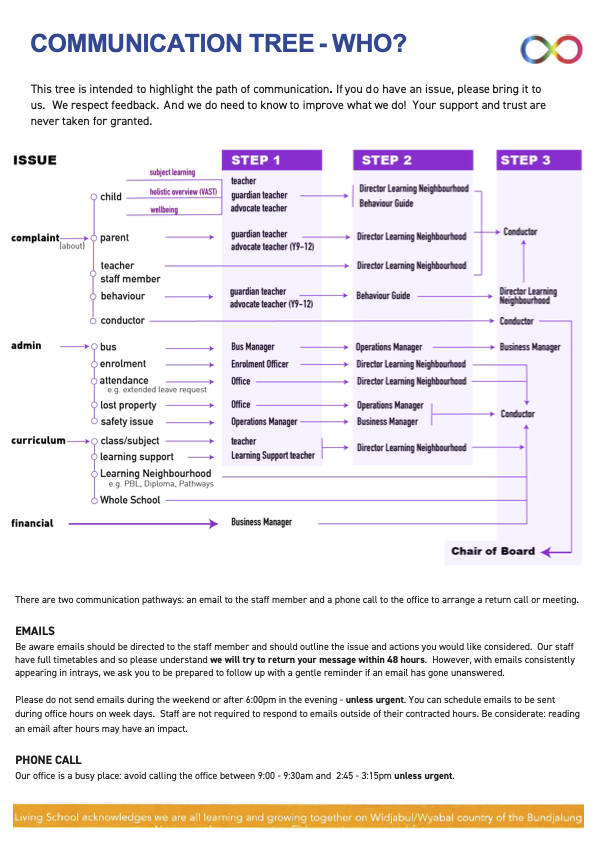
COMMUNICATION TREE
Review: January 2027
